22 July 2013

Week 3, part five, Watergate, kayaking and giant insects on the loose!

Here's something they have in the U.S that we don't have (as much) in the U.K. Giant insects. I found this one under a sofa cushion, and named him Houdini.

This is just a bench that amuses me whenever I walk past it. How did it come to be so slanted?! Is it a piece of post-modern art?


I ended up walking past the Watergate hotel complex whilst I was in the Foggy Bottom area of town the other day. All of my GCSE history memories flooded back! I find it odd that people still live there, and that apartments and the hotel continue to this day. I guess they probably benefit from its notoriety.
 
The highlight of the weekend was kayaking across the Potomac river. A group of us rented the kayaks (which had 2 people per boat, where as I always thought that canoes had multiple people, and kayaks were singular?) and paddled around for a bit, looking at the waterfront from the water. We were able to see the bridge that we had walked over to get to Georgetown (the place with the famous cupcakes!) a few weeks ago. In the other direction we got some greta views of the Lincoln Memorial and Washington monument. The trees in the middle of the image are on a small, sandy island, which we landed on to eat lunch! The island had these large, black, white & yellow butterflies which no one was able to photograph. I loved the fact that it forms a mini-beach in the middle of what is otherwise a thoroughly metropolitan city. This is visible in the photo with the high-rise buildings in the background.


*In case anyone was wondering, there is just as much, if not more coverage of the Royal baby in the U.S than in the UK. CNN, Fox and every other news channel have been updating on this story all day, even contrasting the use of C-sections and epidurals in England and America in a special programme. There is hardly any regional or even national news, which is amazing for a nation the size of the States.  If you're one of those people who dislikes coverage of these events in the UK, think how much worse it is in the U.S.A, for whom the British Royal family is irrelevant - otherwise what was the purpose of the prided War & subsequent Declaration of Independence?

21 July 2013

Week 3, part four

Definitely the biggest sporting venue I've ever been in.
On friday I went to my first baseball game. I didn't really know how baseball worked (as someone in my house sarcastically pointed out, "it's not cricket you know!") but a group of us British interns were accompanied by some Americans and a Canadian, so all was well!

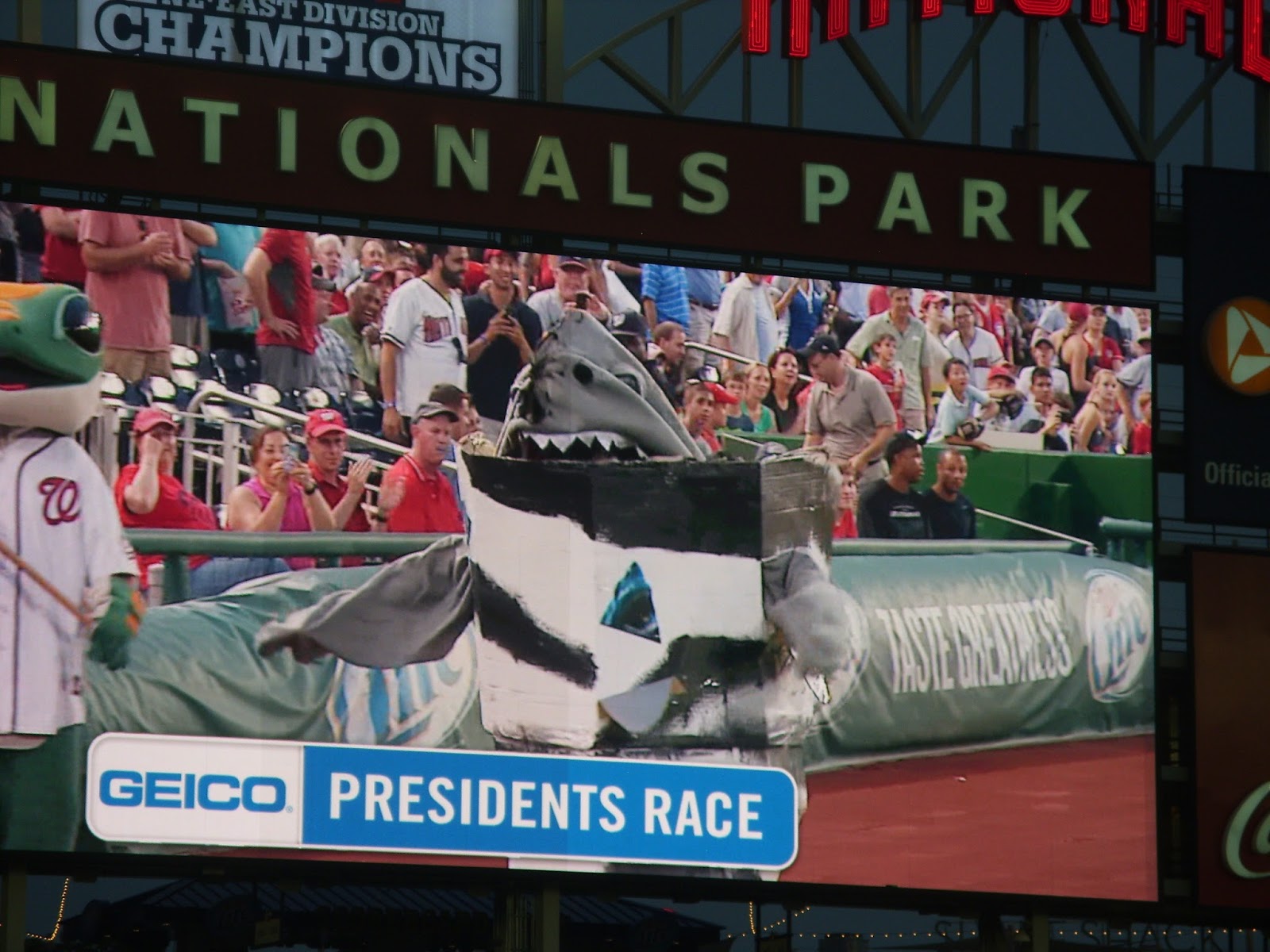
One of the most striking (just realised that that's a pun!) things about the game was the show that surrounded the sport. The National Anthem preceded play and music was played as the players walked out and warmed up. Phrases like "GREAT HIT" and "STRIKE!!" kept flashing onto large, omnipresent screens. Even as the game was played, t-shirts were thrown into the crowd by mascots, food was given away by official sponsors, and there was even a mascot race around the pitch!
Constant images, adverts and information updates!
It was deemed perfectly acceptable to leave your seat to buy food, which people did frequently. Food could be ordered by mobile phone, using the stadium's wi-fi. That fascinated me. I should clarify, the game we saw was the Los Angeles Dodgers vs. the Washington D.C Nationals. This was considered quite a big game by people who know about these things, many more of my housemates wanted tickets for this game, but they were sold out by the time they tried to book.

The Sharknado!
Baseball is all about entertainment. Whenever the crowd was too quiet, a "noisemeter" would flash up, and encourage people to cheer louder. People also joined in with a "dance break" which happened during the middle of the Innings. The fans who were dressed the wildest were also given free merchandise.

The mascots were the founding fathers, accompanied by a sharknado, as in, from the Sharknado film I mentioned in a previous post. Seeing the Sharknado come out was a personal highlight. The game lasted for 3 hours, but I didn't actually leave my seat (beforehand I acquired a box with a hotdog and nachos...although according to the Americans we were with, popcorn and peanuts are traditional baseball match food). Now I actually know what the "strikes" and those running people mean! Well, vaguely...

I think I may have a better understanding of the baseball "hype" in the U.S now. It's completely absorbing if you allow yourself to get caught up in the party-like atmosphere. Maybe there's still hope for me as an enthusiastic sports spectator, just not in England...

Week 3, part three, Work

Front of the Navy Yard museum
I realised I haven't said much about what I do during the week, when I'm not sight-seeing.

I work in the Navy museum's Education Department, which gives tours, home-school lessons, and summer camps, as well as hosting school visits. I work with a team of American interns who are all college students and History "majors" (History is the primary focus of their studies), some come from as far away as Los Angeles, California, but most are local, from Virginia, Arlington and Maryland. We write up lesson plans, using books and the museum's existing curriculum, we make up folders for the students and we set up experiments and equipment for the activities in lessons!

The last week saw the beginning of the first of the summer camps, based around the construction of an underwater ROV (remotely operated vehicle). Each day has a lesson (focusing on Naval history, e.g. how an underwater ROV uncovered the Titanic, or a reel of American satellite film during the Cold War) an activity (e.g. making "submarines" out of water bottles, coins and tape) and then the students work in groups to make their robots, with us assisting them.

The students, who range from about 9 to 15 years old, are sometimes accompanied by parents and relatives, sometimes not. A few of the "moms and dads" help out with the circuit boards because they're engineers or they have experience with electronics. Despite the fact that I haven't held a soldering iron in over 5 years, nor have I ever used a drill, I've really enjoyed helping each group with their project! It's incredible how much even the youngest students are capable of, watching them finally get to race their under water vehicles in a horse-trough was very rewarding!
Barry! Display ship (retired Destroyer) docked outside the museum.
A pretty unique surrounding to work in...

Army personnel regularly turn up just to see what's going on, or to look around the museum. Sometimes they observe lessons, or help out. Live music streams every morning as I walk past the Marine Barracks, I think it's a marching band which accompanies the raising of the flag or something.

2 Awkward moments whilst running the camp this week;

  1. A 10 year old boy is playing on one of the guns in the museum, shooting at an imaginary enemy. "Who are you shooting at?" I ask, "the British of course!"he replies...
  2. Some of the younger children seem to have trouble understanding my accent. One boy watched me give a safety demonstration only to ask at the end; "what are googles?". Now I say "safety glasses". In addition, it took about 5 minutes to clarify what the word "soldering" meant, because in the U.S it's pronounced "SAW-DER-RING". Also, petri dishes are pronounced "PEE-TREE" dishes. This is just like the "pipe-ettes" episode.

20 July 2013

Week 3, part two

WW2 memorial
We decided to tour the memorials by night, when the temperature was cooler and the crowds smaller. Despite the influx of biting insects, seeing the Washington monuments by night was a great way to see the city lit up, and in a more tranquil setting than during the day.

WW2 memorial/ Washington monument
The WW2 monument is incredible, it has a pool, fountains, a pillar for every U.S State and territory. Two sides completed with columns and wreaths, representing the Atlantic and Pacific Ocean. One the floor, symbols like the American eagle, the Latin, E pluribus unum ("Out of many, one") decorate the tiled floor.

WW1 monument

Lincoln memorial exterior


Lincoln memorial interior

The monuments that struck me the most were either World War Two, or the Lincoln Memorial, which conjured up odd memories of both Martin Luther King Jr.’s I Have a Dream speech, and Forrest Gump, in equal measure. To me American history genuinely appears as a combination of moments which determined the course of the modern world, and famous parodies mocking such moments which are almost as famous. As someone here reminded me, the entertainment industry is America’s biggest export, and so they make a point of doing it well.

We also visited the Korean, Vietnam, WW1, and Albert Einstein memorials.
Vocabulary learnt;
Panhandling - begging

18 July 2013

Week 3, part one

Yet another view of the Capitol
This week's "field trip" for us British interns of the Navy museum was the United States Botanic Garden on Capitol Hill.


It was like Kew gardens, but in Washington D.C. So basically, Kew gardens, with a view of the Capitol Building in the background, and no temperature or humidity difference between the green houses and the outside. In fact, I’m pretty sure we discovered that some of the greenhouses were actually less sticky than walking around outside…

Botanical Gardens

Washington D.C: where greenhouses are less humid than your own office/ apartment.
Titan Arum, one of the largest flower species in the world, over 6 foot
This flower blooms very rarely, it even has a webcam on it constantly, to monitor its progress. Anyway, the day after we go to the gardens, it begins to blossom. Typical. Although, it is nicknamed the "corpse" plant, and it is supposed to smell "like roadkill on a hot day" so missing that may have been a blessing in disguise!

Tropical!
 
See, just like Kew Gardens/ a greenhouse, with the Capitol in the background
After the Botanic gardens we were going to go to get a tour around the Capitol, but they wanted to throw away my bag. More specifically, their security arrangements demanded that all food, drink, bug spray, sun tan lotion etc. be discarded, and as that was practically everything I had on me, I decided it wasn't worth it and went to the Air & Space museum instead.  
 
Planes!
The Air & Space museum is one of the biggest in the world. Walking past security, and into the museum itself, felt like walking into an airport terminal, a feeling magnified by the height of the ceiling and glass walls.
 
How hot air balloons should be...
 
Although the Air & Space museum is one of the most popular attractions under the Smithsonian banner, I have to admit that I'm not that mad on air and space travel. 4 well-spent hours later though, I have been somehwhat converted. Ok, so 1/2 an hour of the total time was spent going through security (a school of Chinese children arrived just prior to me...) but the rest of the time I was busy admiring aerial exhibits and poking bits of rock, supposedly from the moon (I mean, it could have been fake, and I wouldn't have be able to tell - who would?)

Most fascinating things learnt;

  • The Aral sea is shrinking
  • "Planet" comes from the Greek word "planetes", meaning "wanderer"
  • Io (a moon of Jupiter's) is the only object in this solar system, other than Earth, that shows signs of current volcanic activity
  • Telescopes are actually time machines, because we are seeing things that happened days/ months ago by the time light reaches us on Earth
  • The "Big Bang" was an explosion OF the universe, as it expanded, not an explosion into some finite "space"
  • If cars could drive straight up, vertically, "space" is only 1 hour away
  • The distance, by car, between Washington D.C and New York City is how high above Earth the International Space Station is
  • Barrage Balloons were hung over Buckingham palace during WW2 to prevent German bombers from getting too close
Seeing the drawings of the Wright brothers reminded me of the sketches from Da Vinci's notebook, which I studied last term. Perhaps the most arresting thing I saw was a display screen of the U.S air control, with the pathways of different flights, and their directions, appearing as coloured lines which zig-zag across the States. In the bottom left-hand corner was a timer, with the hour and date. The footage for 9/11, after about 10am, shows an ominously dark screen, as the lights representing flights, the colours and the lines, disappear one by one.

17 July 2013

Week 2, part six


The next day I visited the Whitehouse, because you can’t come to D.C and not try (“try” being the operative word considering the security cordons) to see the Whitehouse. I did succeed, to an extent, though the zoom feature of my camera was put to good use. A more interesting story is that when I was walking to the Whitehouse I went to a McDonalds kiosk to get some chips (“fries”) because the last time I tried to go into an actual McDonalds restaurant here it was surrounded by police, and I was later told that inner-city McDonalds is best avoided as it attracts criminals who prey on tourists, not to mention concerns over food hygiene. Rest assure, I did safely acquire my (by this time) much desired chips but only after this exchange;

 Server; “May I take your order Ma’am?”

Me; “Yes, thank you, I’ll have some small fries please”

Server; looks confused, “you want fries?”

Me; “Yes please”.

Server; “what size?”

Me; “small”

Server, to another member of staff; “Can I get some regular fries please!”

Me; “and can I please have some tomato sauce too”

*server hands me 7, that’s right, S-E-V-E-N sachets of ketchup”

 So, either they misunderstood my accent, or there is no such thing (as I have long suspected) as a small portion of anything in the U.S. By the way, the chips I was served, whether they were officially “small” or “regular” were the size of “large fries” back in the U.K.

Later, I ended up in Dupont Circle, with some Americans (roommates of another British intern) in Starbucks. This is ironic due to the cultural context of the Dupont Circle area of the city. Traditionally, Dupont Circle was the “anti-establishment” part of Washington D.C, filled with vintage shops and gay bars and “alternative” fashion. Now, like the rest of D.C, there resides a Starbucks within sight of the Metro stop (fantastic strategy for attracting the commuters, sick of heat and humidity!) and on the one hand I thought this was a sad product of mass marketing and globalisation, but on the other hand I just really, really, wanted a cold drink.


Words I/ we (the other British interns) have taught the American interns:

-“Jubilee” (obviously they have no need for this one!)

- “Keen”, apparently this word doesn’t exist here, though they now know what it means. A whole intern house full of Americans have gone on to adopt the word and use it in virtually any phrase, just so they can shout “KEEN” at each other in mock-British accents and rhyme it with the word “queen”.

Week 2, part five


Visiting Arlington National Cemetery was a strange experience. We don’t have any cemeteries so vast in England. The atmosphere was a mixture of sobriety and pomp. The graves of the Kennedys are simple, with plain wooden crosses and plaques, but somehow they are all the more powerful that way. J.F Kennedy’s eternal flame (a constantly burning torch in his memory) is surrounded by some of his most famous quotes. The tomb of the Unknown Soldier is accompanied by a guard of honour, which march along an elevated white marble strip, armed and in uniform, and change position frequently, in a ceremony which everyone is required to stand for. I read on a sign, which I had to check twice, that over 2,000 men are buried in a mass civil war grave. All of this takes place in a setting of hills, streams and greenery, offset by Grecian style monuments. The view from the cemetery overlooks the entirety of D.C, because of the low-rise style of the District of Columbia’s buildings. The Pentagon is also visible on the right hand side, and is the next Metro stop on that line.

Panoramic view of D.C from the house of General Lee, preserved at the cemetry


 More darkly, Arlington National Cemetery is also a story of revenge. The cemetery was established on the family estate of General Robert E. Lee, leader of the Confederate forces during the American Civil War. This was so that even if the Confederate defeated the Union, General Lee would never be able to return home without being confronted daily by the graves of those who had died during the conflict, and the guilt that that would bring.

Looking back towards the Lincoln Memorial
 
Perhaps it is because the cemetery looks over the Washington monument, the Capitol building, the Lincoln memorial, but the place really extrudes an aura of being in the middle of history, rather than belonging firmly in the past. Even today hundreds flock to walk the well-trodden paths of the cemetery, to watch the guard changing and bells chiming over the hills. I couldn’t help but think that, on September the 11th 2001, the plane which was driven into the Pentagon would have been visible to anyone standing towards the summit of the cemetery, by the graves of the Kennedys for example.


View of the Jefferson Memorial from the cemetry